
Advances in Real-Time Monitoring for Tailings Facilities: AI, IoT, Drones & Satellite Technology
- anutsuglo
- Dec 4, 2025
- 2 min read

As the mining industry evolves, the shift from manual inspection to real-time, data-driven monitoring has become one of the most important advancements in tailings facility (TSF) safety.
With increasing regulatory expectations, rising ESG commitments, and the need for stronger risk prevention, modern mines are embracing technologies that make monitoring faster, smarter, and more predictive.
Today, the most progressive TSF operations rely on four major technologies: AI analytics, IoT instrumentation, drone surveillance, and satellite-based deformation tracking. Together, these tools provide the continuous visibility required to detect anomalies early and strengthen decision-making.
Below are the key innovations shaping the future of TSF monitoring in 2025 and beyond.
1. IoT Instrumentation: Real-Time Data From the Ground Up
IoT-enabled sensors have transformed traditional TSF instrumentation.Instead of manual readings, engineers can now receive:
Live pore pressure measurements
Real-time deformation and settlement trends
Continuous seepage and flow readings
Automatic alerts when thresholds are exceeded
Smart piezometers, inclinometers, and vibrating wire sensors transmit data wirelessly, allowing operators and engineers to track conditions from anywhere, even during heavy rainfall or after seismic events.
This is the foundation of a modern early-warning system.
2. Artificial Intelligence & Predictive Analytics
AI is changing the way TSF data is interpreted.Instead of reviewing data point by point, AI identifies trends that human eyes may miss, such as:
Developing patterns of rising pore pressure
Very small movements that indicate early instability
Changes in drainage behaviour after storms
Machine-learning-based predictions of potential failure paths
AI strengthens TSF governance by shifting the system from reactive monitoring to predictive safety intelligence.
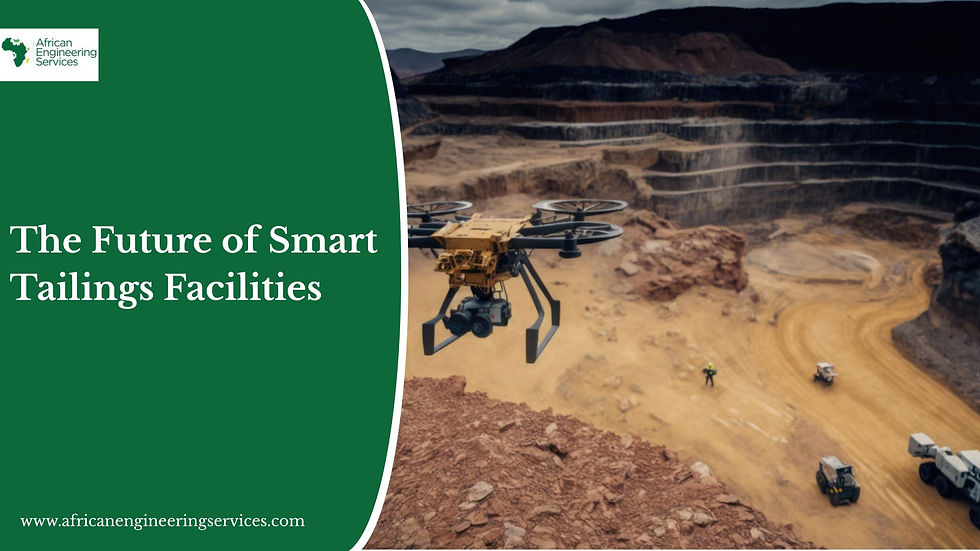
3. Drone-Based Monitoring & Aerial Inspections
Drones provide powerful visual insights that ground teams cannot easily capture.
Using drones, engineers can conduct:
High-resolution mapping
Thermal imaging
Monitoring of pond size and beach geometry
Crack detection
Rapid inspections after extreme weather
Drones reduce inspection time, increase safety, and provide a consistent visual record that supports TSF auditing and reporting.
4. Satellite Monitoring (InSAR): Seeing What the Eye Cannot See
Satellite-based monitoring technology (InSAR) detects millimetre-level ground movement over very large areas.
This allows engineers to identify:
Settlement
Horizontal displacement
Slope movement
Deformation trends not visible during daily inspections
Because InSAR data captures changes over time, it is one of the strongest tools for verifying long-term TSF stability.
Why This Matters for the Mining Industry
Modern TSF monitoring requires integration, combining instrumentation, drones, satellites, and AI into one cohesive system.
This multi-layer visibility:
Strengthens safety
Enhances compliance (GISTM, environmental standards)
Reduces operational risk
Speeds up emergency response
Builds confidence with regulators and host communities
The mines that invest in real-time monitoring now are the ones best positioned for safe, sustainable operations in the coming decade.
African Engineering Services: Delivering the Next Generation of TSF Monitoring
At African Engineering Services (AES), we support mining clients with advanced monitoring solutions that combine:
Smart IoT instrumentation
Real-time data dashboards
AI-supported interpretation
Drone-based inspections
Satellite deformation tracking
Continuous geotechnical review and reporting
We help operators move from traditional monitoring to a modern, integrated system that improves decision-making and strengthens TSF resilience across West Africa.


Comments