
The Future of Smart Tailings Facilities
- anutsuglo
- Dec 29, 2025
- 2 min read
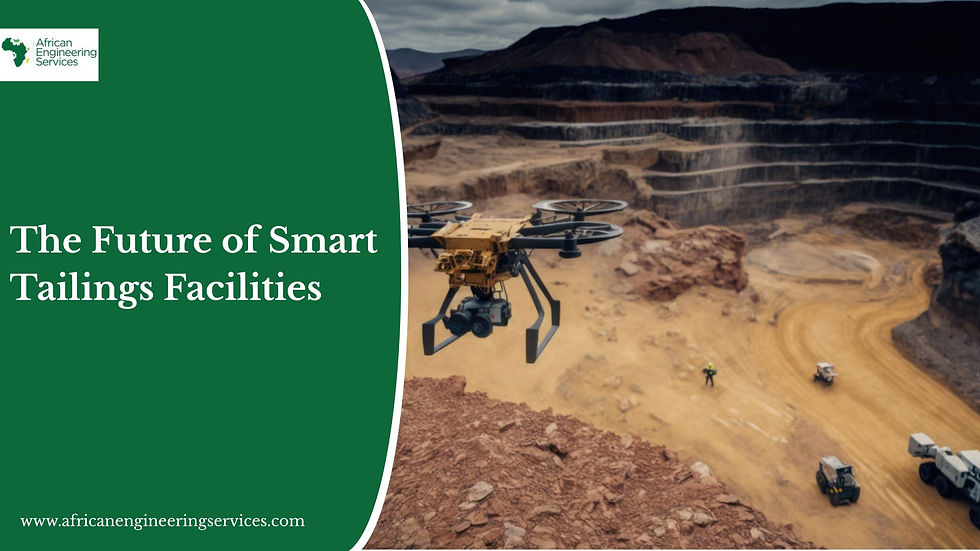
As mining operations evolve, tailings storage facilities (TSFs) are no longer viewed as static structures. They are increasingly becoming smart, connected systems that integrate data, technology, and engineering judgement to improve safety, transparency, and performance.
The future of tailings management lies in smart TSFs facilities that continuously learn, adapt, and respond to changing conditions.
What Defines a Smart Tailings Facility?
A smart TSF combines engineering design, real-time data, and digital tools to support proactive decision-making throughout its lifecycle.
Key characteristics include:
Continuous performance monitoring
Data-driven risk assessment
Early warning and alert systems
Transparent reporting and governance
Integration of human expertise with technology
Rather than reacting to problems, smart TSFs aim to anticipate and prevent them.
1. Real-Time Monitoring as the Backbone
Smart TSFs rely heavily on real-time instrumentation such as:
Piezometers
Inclinometers
Water level sensors
Flow meters
Weather stations
These instruments feed live data into centralized dashboards, allowing engineers to detect abnormal trends early and take corrective action before risks escalate.
2. AI, Automation & Predictive Analytics
Artificial intelligence and advanced analytics are transforming raw monitoring data into actionable insight.
With predictive models, operators can:
Forecast pore pressure changes
Anticipate settlement and deformation
Identify emerging instability patterns
Prioritize maintenance and inspections
This shift from reactive monitoring to predictive risk management is a major step forward for TSF safety.
3. Digital Twins & Integrated Platforms
Digital twins create a virtual representation of a TSF that mirrors real-world behaviour.
By linking live monitoring data with numerical models, engineers can:
Test “what-if” scenarios
Evaluate design or operational changes
Support safer decision-making
Improve communication with stakeholders
Smart TSFs increasingly rely on integrated platforms that bring together design, monitoring, inspection, and reporting in one system.
4. Drones & Satellite Surveillance
Unmanned aerial vehicles and satellite technologies are now essential tools in smart tailings management.
They support:
High-resolution surface mapping
Deformation detection
Dam crest and slope inspections
Independent verification of stability
These technologies enhance site coverage, reduce safety exposure, and improve inspection frequency.
5. Transparency, ESG & Community Confidence
Smart TSFs also play a critical role in building trust.
With improved data quality and reporting systems, mining companies can:
Demonstrate compliance with standards such as GISTM
Share performance indicators with regulators
Communicate risks more clearly to communities
Strengthen ESG credibility
Technology is becoming a bridge between engineering performance and social licence to operate.
Looking Ahead
The future of tailings management is not just about stronger dams, it is about smarter systems.
Mines that invest in smart TSFs will be better positioned to:
Reduce operational risk
Improve regulatory compliance
Adapt to climate uncertainty
Protect people and the environment
Innovation is no longer optional; it is becoming central to responsible mining.


Comments