
Global Industry Standard on Tailings Management (GISTM): Why It Matters for Africa’s Mining and Infrastructure Future
- anutsuglo
- Sep 4, 2025
- 3 min read

Mining has long been the backbone of Africa’s industrial growth. From gold in Ghana to copper in Zambia and cobalt in the Democratic Republic of Congo, mineral resources continue to shape economies across the continent. But behind the promise of wealth lies one of the industry’s greatest risks: tailings management.
When tailings facilities fail, the results are catastrophic. The Brumadinho disaster in Brazil (2019) killed more than 270 people and sent shockwaves through the global mining industry. In response, three global organizations; the International Council on Mining and Metals (ICMM), the United Nations Environment Programme (UNEP), and the Principles for Responsible Investment (PRI) developed the Global Industry Standard on Tailings Management (GISTM) in 2020.
For Africa, where mining is central to economic development, GISTM is not just another guideline. It is a lifeline for communities, workers, investors, and the environment.
What is GISTM?
The Global Industry Standard on Tailings Management sets out 15 principles to guide the safe management of tailings facilities across their entire lifecycle from design and construction, through operation, to closure and post-closure monitoring.
The standard is built on three fundamental pillars:
1. Zero harm to people – Protecting communities and workers.
2. Respect for the environment – Preventing water and soil contamination.
3. Transparency and accountability – Ensuring trust through open reporting and stakeholder engagement.
Why Does GISTM Matter?
1. Protecting Communities and Workers
Millions of people across Africa live near mining operations. A single tailings failure can destroy entire villages and farmland. GISTM emphasizes safety-first designs, continuous monitoring, and emergency preparedness to prevent such disasters.
2. Environmental Stewardship
Tailings are often stored as slurry containing heavy metals and chemicals. Poorly managed facilities can leak into rivers and groundwater. GISTM enforces environmental safeguards that preserve ecosystems and safeguard drinking water sources.
3. Investor and Stakeholder Confidence
As the global mining sector faces increasing Environmental, Social, and Governance (ESG) scrutiny, compliance with GISTM has become a requirement for attracting international funding. Projects that meet the standard are more likely to secure investment and partnerships.
4. License to Operate
Governments and regulators in Africa are under pressure to tighten mining oversight. By aligning with GISTM, companies not only ensure compliance but also reinforce their legitimacy and long-term social acceptance.
The African Perspective
Mining remains both an opportunity and a risk for African nations:
Ghana: One of the continent’s leading gold producers with increasing pressure to improve mine waste safety.
South Africa: Home to hundreds of active and abandoned tailings dams, many posing risks to nearby communities.
Zambia and DRC: Copper and cobalt mining hubs where sustainable practices are becoming essential to global supply chains.
Yet adoption of GISTM principles in Africa has been slower than in other regions. For companies seeking to attract global investors and remain competitive, aligning with international best practice is no longer optional it is critical.
How African Engineering Services Contributes
At African Engineering Services, we help bridge the gap between traditional engineering expertise and modern global standards. Our contributions to tailings management include:
Surveying and Site Investigations – Delivering accurate geotechnical and topographical data for safer tailings dam design.
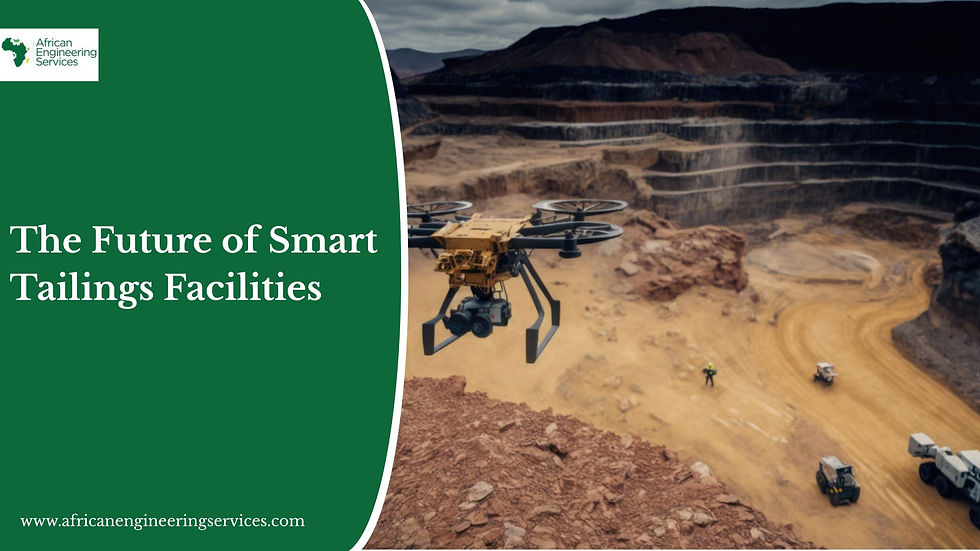
Monitoring and Inspection Support – Using drones, GIS mapping, and engineering knowledge to ensure continuous oversight of facilities.
Capacity Building – Supporting mining projects across West Africa to meet GISTM and other international standards.
Conclusion
The Global Industry Standard on Tailings Management (GISTM) is not merely a set of rules. It is a commitment to safety, sustainability, and accountability. For Africa, where mining drives economic growth, adopting GISTM can help build a future where resource extraction supports prosperity without compromising lives, livelihoods, and the environment.
At African Engineering Services, we are committed to helping partners across West Africa and beyond to meet global best practices in surveying, engineering, and tailings management. Together, we can build a mining sector that is both profitable and responsible.


Comments